Registrar of Companies - ROC Compliance
ROC stands for the Registrar of Companies, which is a government office under the Ministry of Corporate Affairs (MCA). While "Registration of Compliances" is a common way to describe it, the official term is ROC Compliance—the mandatory legal requirement for every Company and LLP in India to file their financial and administrative data with the government every year.
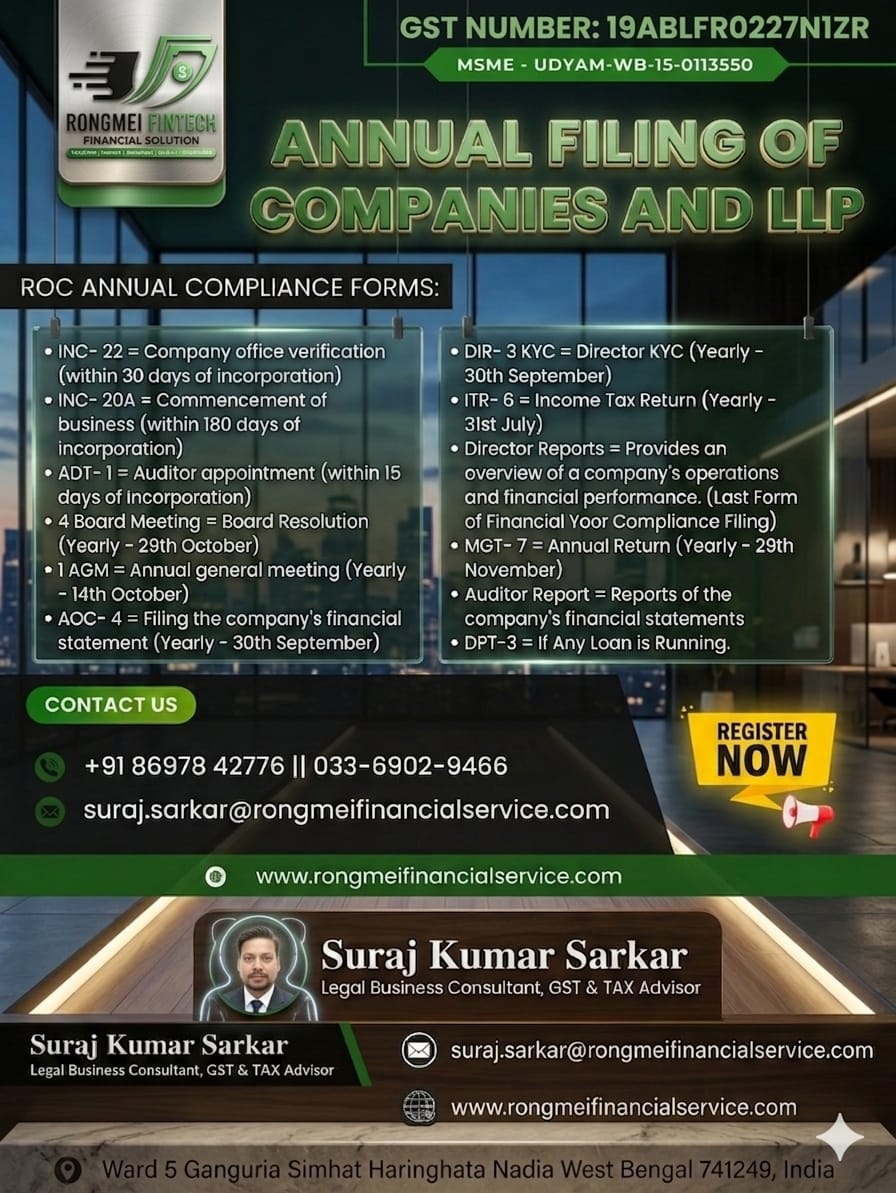
ROC - Annual Filing of Companies and LLP
PVT. LTD. / OPC / LLP / TRUST / NGO /SOCIETY
1. What is the ROC?
The ROC is the "watchdog" of the corporate world in India. Every State has its own ROC office (e.g., ROC Mumbai, ROC Delhi). Its job is to:
- Maintain a public record of all registered businesses.
- Ensure that companies are operating transparently.
- Monitor whether companies are holding meetings and paying debts
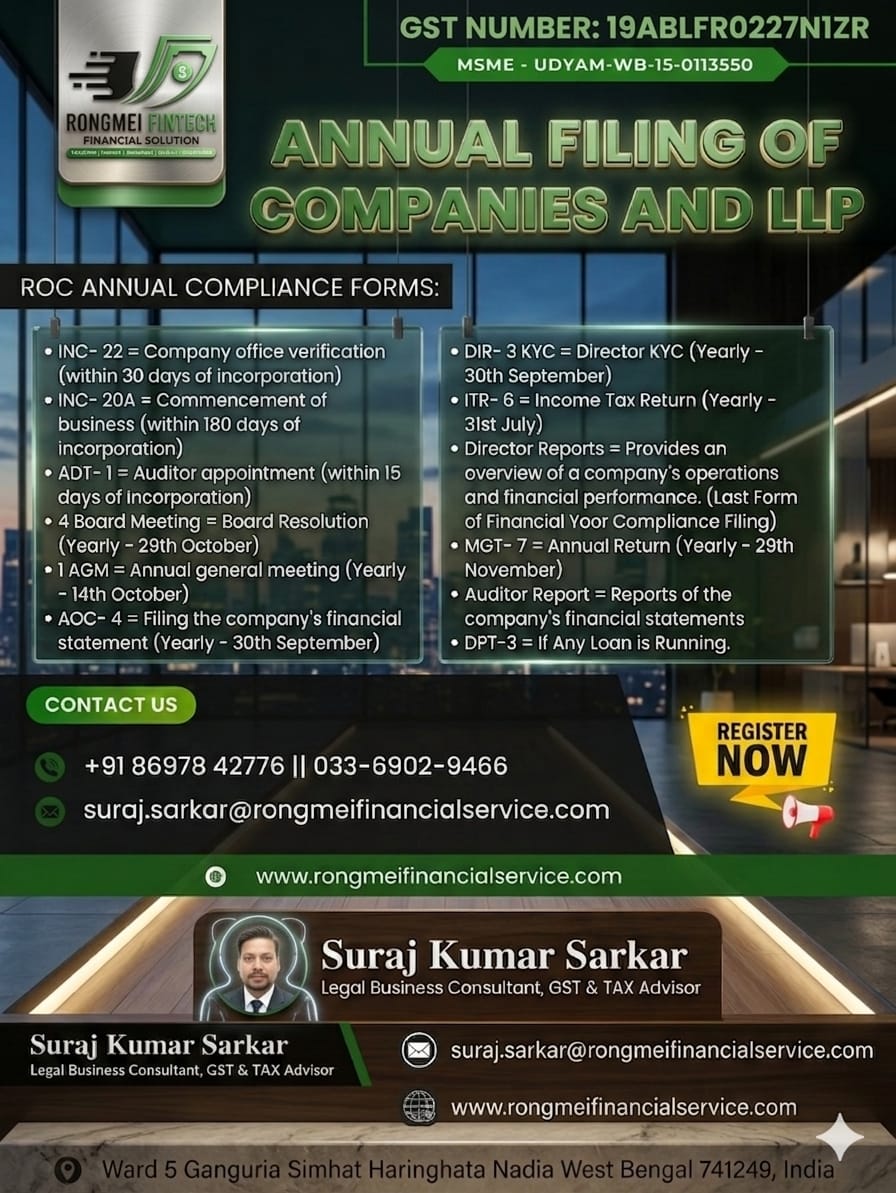
2. The "Must-File" Annual Compliances (2026)
Every company, even those with zero turnover, must file these forms annually to avoid being "struck off" (shut down) by the government.
FormPurposeKey Deadline (for FY 25-26)AOC-4Filing of Audited Financial Statements (Balance Sheet & P&L).30th October 2026MGT-7/7AAnnual Return (Details of Shareholders and Directors).29th November 2026DIR-3 KYCVerification of Director's details (Aadhaar/PAN/Phone/Email).30th September 2026DPT-3Return of Deposits (reporting any loans taken by the company).30th June 2026MSME-1Reporting outstanding payments to MSME vendors (>45 days).Half-Yearly (Apr & Oct)
3. Event-Based Compliances
Unlike annual filings, these are "triggered" only when a specific change happens in your business:
- DIR-12: Filed within 30 days of appointing or removing a Director
- INC-22: Filed if you change your Registered Office address
- PAS-3: Filed if the company issues new shares to someone.
- SH-7: Filed if you increase your Authorized Share Capital.
4. Big Update: The CCFS-2026 Scheme
If your company has missed previous filings, the government has just launched the Companies Compliance Facilitation Scheme (CCFS), 2026.
- Window: April 15, 2026, to July 15, 2026.
- Benefit: You can file old, pending returns by paying only 10% of the usual penalty. This is a rare "clean-up" opportunity to avoid director disqualification.
Section 8 Company - ROC
For an NGO registered as a Section 8 Company, ROC (Registrar of Companies) compliance is mandatory to maintain its "Active" status and tax-exempt benefits. Unlike a Trust or Society, a Section 8 Company must follow the strict digital filing ecosystem of the Ministry of Corporate Affairs (MCA).
1. Mandatory Annual ROC Forms
These must be filed every year, regardless of whether the NGO had any activity or donations.
FormPurposeDeadline (FY 2025-26)AOC-4Filing of Audited Financial Statements (Balance Sheet, P&L, Auditor's Report, and Director's Report).Within 30 days of AGM (Approx. Oct 30)MGT-7Annual Return containing details of directors, members, and any changes in the board during the year.Within 60 days of AGM (Approx. Nov 29)DIR-3 KYCVerification of Director’s details. Every person with a DIN must verify their phone and email via OTP.30th September 2026ADT-1Intimation of Auditor Appointment. Usually filed once every 5 years, unless the auditor is changed.Within 15 days of AGMDPT-3Return of Deposits. Used to report any loans or money received that aren't considered "deposits."30th June 2026
2. Key NGO-Specific Relaxations
Section 8 Companies enjoy a few "perks" compared to regular Private Limited companies:
- Board Meetings: You only need to hold one meeting every 6 months, whereas private companies must hold four per year.
- Notice Period: General Meetings can be called with just 14 days' notice (instead of 21 days).
- Stamp Duty: Usually exempted or highly subsidized on the Memorandum and Articles of Association.
Warning: If an NGO fails to file AOC-4 or MGT-7 for two consecutive years, the ROC can cancel its Section 8 License and "Strike Off" the company. Once the license is cancelled, all tax exemptions (12A/80G) are automatically at risk.